



💡 The Big Idea
In a previous post, I argued that dual coding is often misunderstood. It is not about decorating slides with icons or adding a random image next to every bullet point. It is not about making lessons look engaging. When Allan Paivio first introduced Dual Coding Theory, the idea was simple. Information is encoded through both verbal and non-verbal systems, and when those systems are meaningfully linked, recall becomes stronger.
This week, I observed a Year 4 persuasive writing lesson that captured that perfectly. Nothing flashy. I thought it was worth sharing because it shows what dual coding actually looks like in action in a primary classroom.
👀 A Closer Look
The learning outcome was clear. Underneath it sat the To Knows. Some would call them success criteria. In this lesson, they were deliberately framed as a checklist.
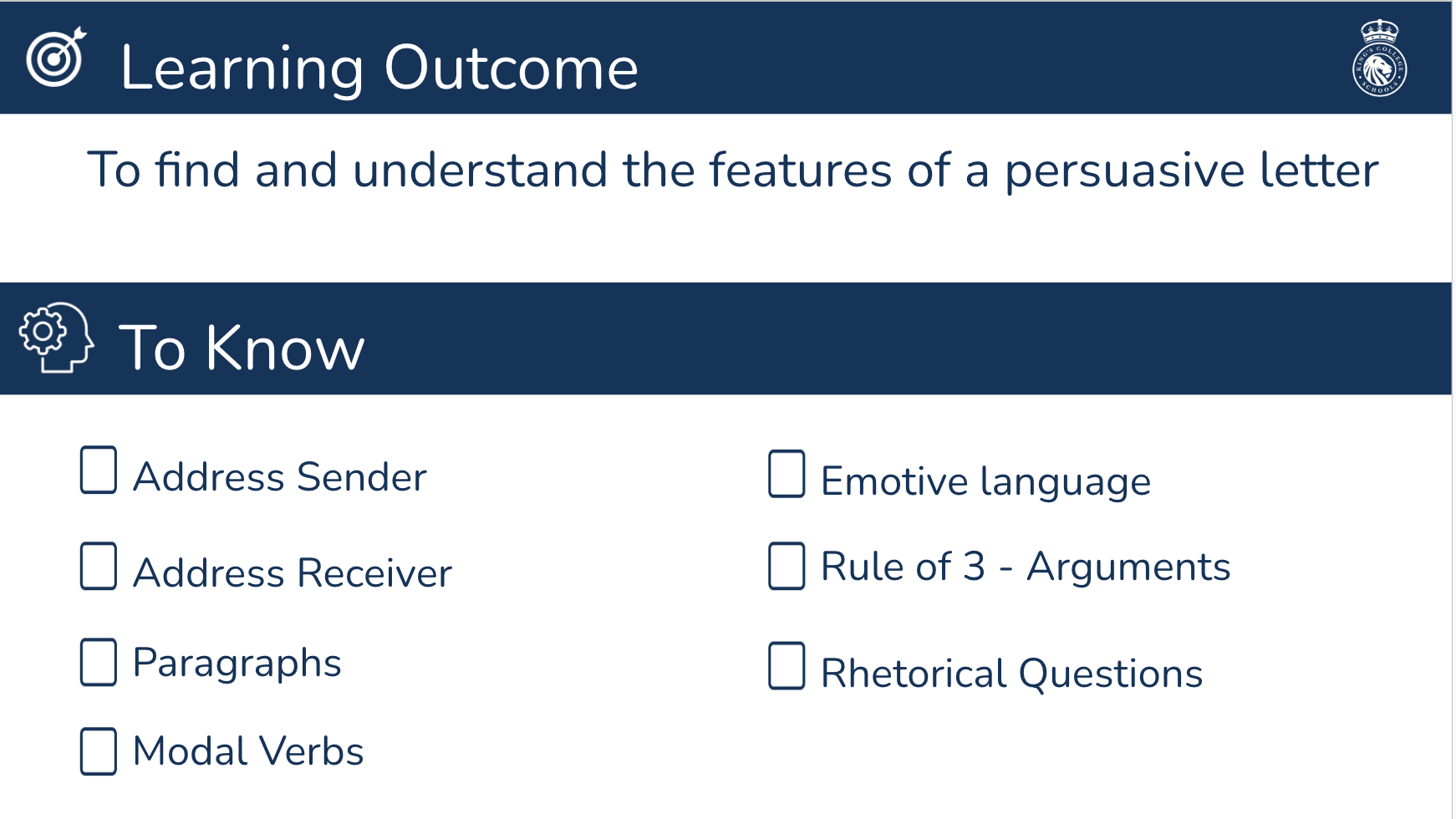
Each item had a small empty box beside it.
At first glance, that’s just tidy slide design. But the layout is doing cognitive work. The tick boxes signal that this lesson is about locating features, not following a sequence. The structure quietly hints to pupils what kind of task they are about to do and how they can track and monitor their progress. As I’ve written before when discussing task design, the template shapes the thinking that happens inside it.
Before a single sentence was read, the children already knew they were hunting for features.
Modal verbs: highlighting and strength
The first feature introduced was modal verbs. On the slide, example sentences were displayed, and the modal verbs were bold. That simple typographical choice narrowed attention. Instead of scanning the entire sentence and guessing what mattered, pupils’ eyes were drawn to the key words.
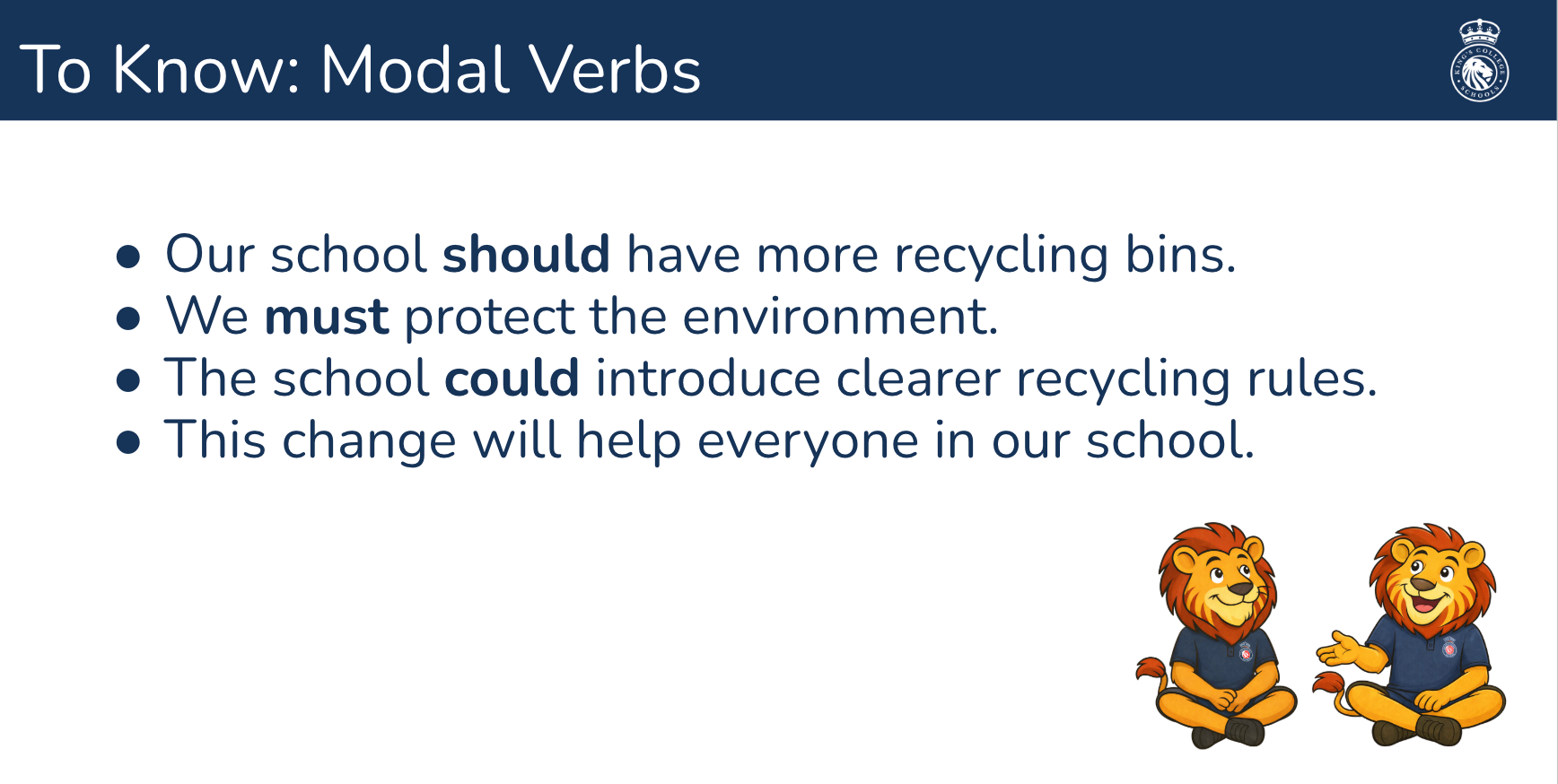
Cognitive Load Theory, particularly in Sweller’s work on worked examples and attention guidance, reminds us that novices benefit when we reduce unnecessary search processes. The bold text did exactly that. It signposted where thinking should begin.
Pairs were asked to discuss what they thought modal verbs were, based on the examples. Then, a horizontal scale on the board from “no” to “yes” was used to place the modal verbs from the sentences along that continuum. As a result, students were visually organising their vocabulary and, therefore, their knowledge of modal verbs in a very explicit way.

This is dual coding in its truest sense. Abstract meaning mapped onto spatial representation. The scale made the concept visible, structured and organised. Instead of holding the abstract idea of certainty in working memory on its own, pupils could see it too.
Emotive language: expressing the sentence
Next came emotive language. As each example sentence was read aloud, pupils were asked to show, with their faces, the emotion the sentence created. Concern. Sadness. Pride.
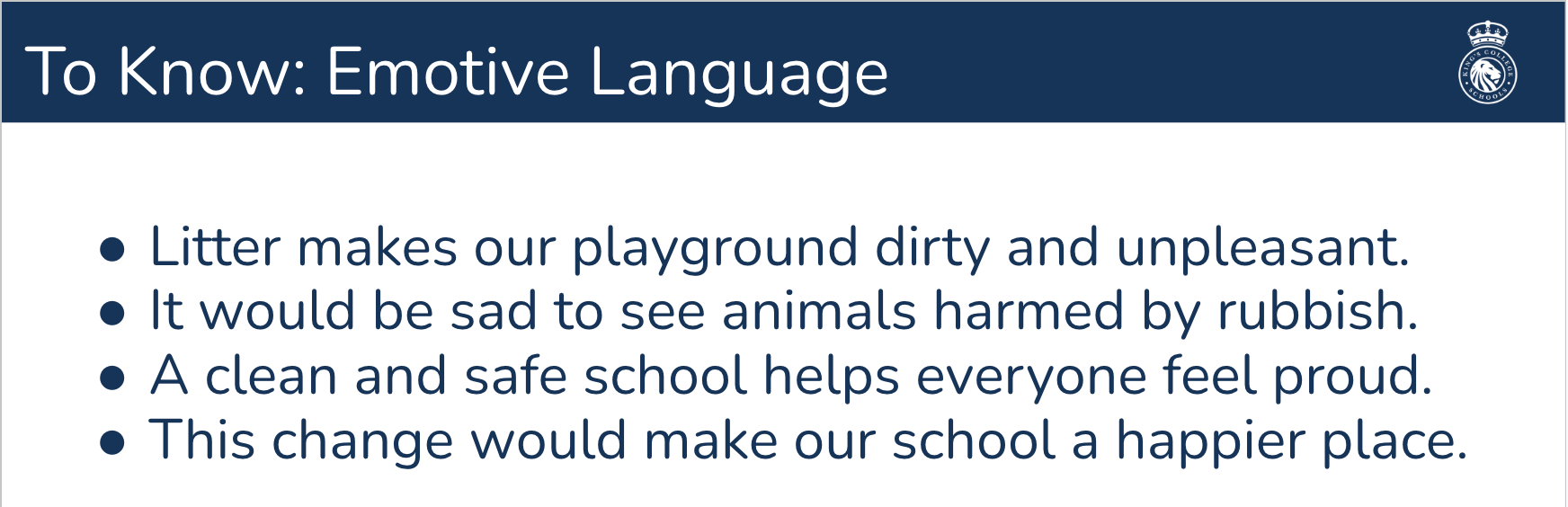
There was a brief moment when a class full of children simultaneously pulled horrified expressions at the thought of animals harmed by litter. It was memorable because it connected language to embodied response.
Research around embodied cognition suggests that physical states and gestures can reinforce conceptual understanding. By pairing the wording with facial expression, the emotional effect of the language was made concrete.
Rule of three: rhythm, fingers and punctuation
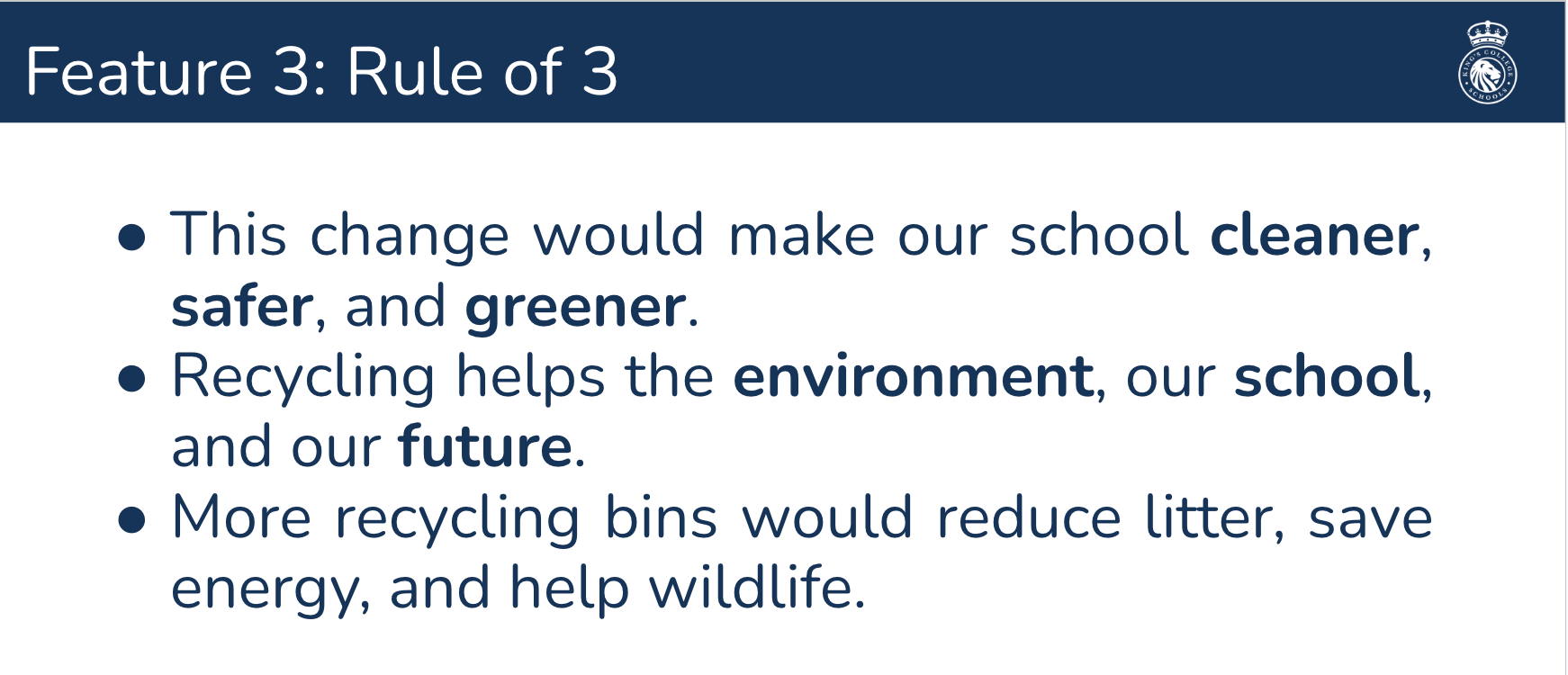
When the rule of three was introduced, the teacher read aloud a sentence such as “cleaner, safer, greener” and held up three fingers in time with each word.

It sounds simple, but isn’t that the beauty of it? The rhythm, paired with a physical count, marked the structure clearly. It slowed the sentence down just enough for the pattern to be made explicit.
Then attention was drawn to punctuation. Two commas and a full stop. The commas became visual clues that reinforced the triple structure. The physical gesture and the punctuation worked together to encode the pattern.
Again, the visuals weren’t decorative. They were structural.
Rhetorical questions: gesture as prompt
Rhetorical questions were approached in a similar way. Pupils were reminded to look for question marks, but also to consider what the question was doing. As the teacher read, “Do we want our school to be full of litter?”, both hands lifted slightly, palms open, as if throwing the question out to an audience.
That small gesture embodied the purpose of rhetorical questioning. It is not about expecting an answer. It is about provoking thought.
From modelling to independence
The class then moved into a We Do under the visualiser, underlining and labelling features in the first paragraph together. Some pupils colour-coded; others simply annotated. The checklist remained visible, and pupils ticked off features as they found them.
By the time they reached independent practice, the slide had transformed from a display tool to a checklist sat beside them. A printed version to be interacted with.
Dual coding as a scaffold
Later, during independent practice, one pupil forgot what the rule of three was. Rather than re-explaining, the teacher simply held up three fingers. The pupil immediately recalled the concept. Another pupil hesitated over rhetorical questions; the open-palmed gesture was enough to trigger retrieval.
What struck me most was how little re-teaching was needed. When pupils forgot, the teacher didn’t return to lengthy explanations. A finger cue. A scale reminder. A facial expression. Each visual anchor quietly did its job.
This is where dual coding becomes powerful beyond initial explanation. The gesture becomes a prompt scaffold. As Rachel Ball describes in her work on scaffolding, prompt scaffolds nudge recall without taking over the thinking.
Without those paired encodings earlier in the lesson, the prompt would have meant nothing.
⭐ WAGOLL+: The Primary Playbook
If you like this post, you’ll love the Primary Playbook for WAGOLL+ members – an ever-growing, primary-specific bank of one-page routines (Do Now, Learning Outcomes, To Knows, I Do–We Do–You Do, Hinge Questions, Show Me, Live Marking, Exit Tickets and more), each with a clear Why, What, and How to do it tomorrow plus KS1/KS2 tweaks.
All yours for just £2.50 a month.
🧠 Why this matters
Dual coding in classrooms is often reduced to adding pictures. But as Paivio’s theory suggests, it is the meaningful linking of verbal and non-verbal representations that strengthens memory. When combined with Sweller’s insights about reducing extraneous cognitive load, the picture becomes clearer. Carefully designed visual and physical cues and structures support thinking and make knowledge easier to encode and retrieve.
In this lesson, dual coding wasn’t extravagant or over the top. It was simple and embedded.
The checklist framed the task.
Bold text guided attention.
A scale made the abstract concrete.
Gestures embodied structure.
Punctuation became a visual clue.
And that is the real point. Dual coding is not about decoration or simply removing content. It is about the deliberate representation and organisation of knowledge.
🧠 The Bits That Stick
✅ Dual coding is more than icons; it is the intentional pairing of words with visual, spatial or physical anchors.
✅ Layout shapes thinking. A checklist implies locating and ticking off features.
✅ Spatial tools, like scales, make abstract concepts visible.
✅ Gestures can become powerful prompt scaffolds that support retrieval without re-teaching.
✅ The most effective dual coding feels simple because it is tightly aligned to the knowledge being taught.
In a bit,
Coops 😎

📚 References
Paivio, A. (1971). Imagery and Verbal Processes. New York: Holt, Rinehart & Winston.
Paivio, A. (1986). Mental Representations: A Dual Coding Approach. Oxford: Oxford University Press.
Sweller, J. (1988). “Cognitive load during problem solving: Effects on learning.” Cognitive Science, 12(2), 257–285.
Sweller, J., van Merriënboer, J. J. G., & Paas, F. (1998). “Cognitive architecture and instructional design.” Educational Psychology Review, 10(3), 251–296.
Sweller, J., Ayres, P., & Kalyuga, S. (2011). Cognitive Load Theory. New York: Springer.
Sweller, J., & Cooper, G. A. (1985). “The use of worked examples as a substitute for problem solving in learning algebra.” Cognition and Instruction, 2(1), 59–89.
Mayer, R. E. (2009). Multimedia Learning (2nd ed.). Cambridge: Cambridge University Press.
Goldin-Meadow, S. (2014). “How gesture works to change our minds.” Trends in Neuroscience and Education, 3(1), 4–6.
Hostetter, A. B., & Alibali, M. W. (2008). “Visible embodiment: Gestures as simulated action.” Psychonomic Bulletin & Review, 15(3), 495–514.
Ball, R & Fairlamb, A (2024). The Scaffolding Effect: How to Help Students Learn. Woodbridge: John Catt Educational.