


The Big Idea 💡
Narrative is one of the most powerful tools we have to support explanations in the classroom. Whether we’re introducing new content or giving instructions for a task, stories help children make sense of what they’re hearing. They reduce cognitive load by providing structure, sequence, and familiarity so learners aren’t overwhelmed. When we teach through narrative, we don’t just hold attention, we build understanding.
A Closer Look 👀
⚽️ I’m sitting this morning watching my 5-year-old daughter attend her first football lesson of Term 3. She’s picked up the new drills quite quickly. Why? Because there’s a story behind each one.
Memory loves structure. And narrative gives us exactly that. A simple, powerful way to organise ideas and reduce the mental effort it takes to learn something new. It’s the sequencing of knowledge.
🧠 Why It Works: Cognitive Load Theory and Episodic Memory
Cognitive Load Theory (Sweller, 1988) tells us that working memory has limits. Overload it, and learning stalls. But we also know that our brains have a natural ability to recall events and experiences - the episodic memory. When information is presented as a story, learners are more likely to remember it because it feels like an experience, not just a list of facts. It sticks because they are living it. Even if it is imaginary!
Narratives help by:
➡️ Organising information into a logical sequence
💭 Engaging imagination, emotion, and motivation
🌐 Connecting new ideas to existing schema
As Oliver Caviglioli explores in Organise Ideas, stories make abstract concepts more concrete and easier to remember.
🏃♂️ Back to Our PE Example
Let's look at a set of PE instructions without narrative:
“One at a time, run into the middle to collect a ball from the centre circle. Weave through the cones on your way back, drop the ball into your team’s bucket, then tag the next player so they can repeat. Only one player can run at a time, and you’ll need to avoid the taggers trying to take your bib.”
That’s a lot to hold in your head, especially while running, weaving, and trying not to get caught. For many children, remembering the full sequence while physically coordinating their movement is overwhelming.
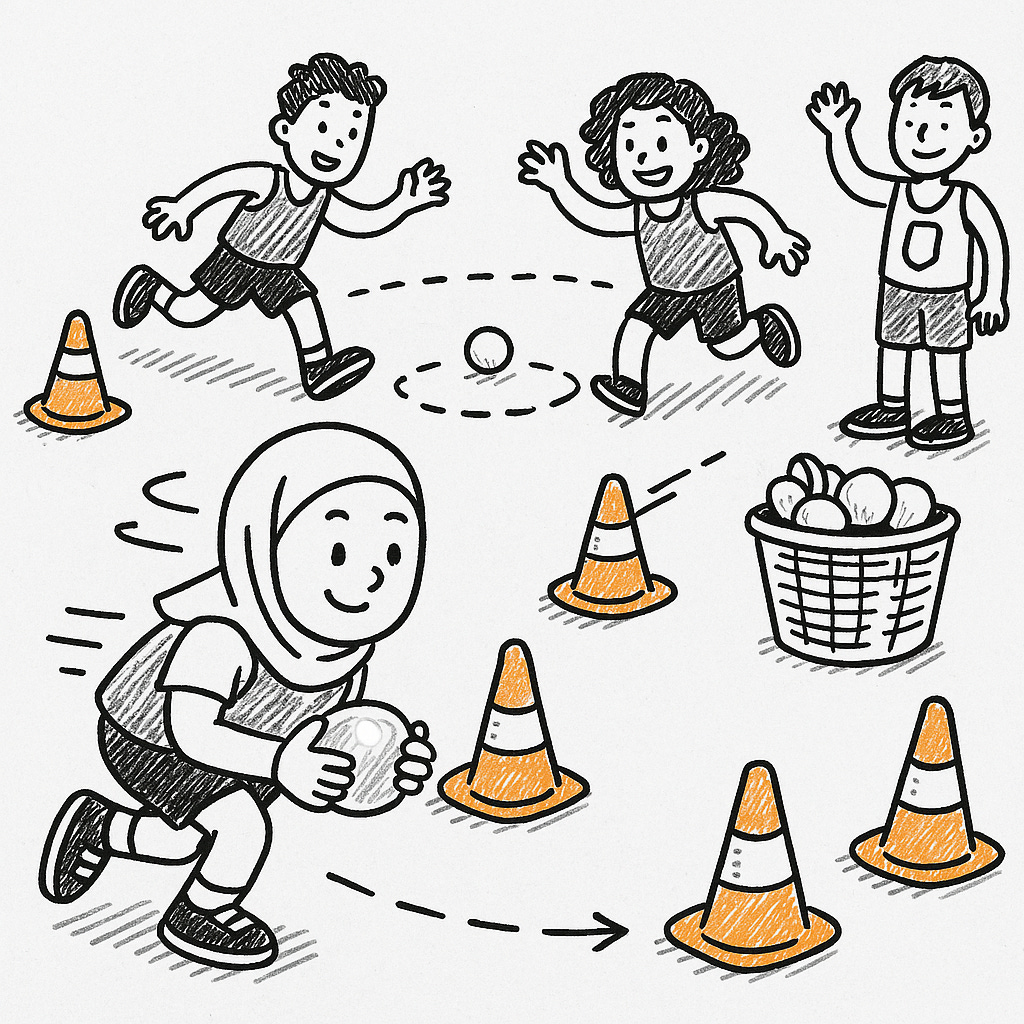
Now let’s look at a set of instructions with narrative:
“You’re a fisher swimming into the middle of the ocean to collect glowing bubbles. But watch out because sharks are circling! Only one fish can be in the water at a time. As you return with your bubble, you have to weave through coral reefs to avoid being caught. Once you reach your home, drop the bubble into your rockpool and tag your fishy friend to go next.”
Now, instead of memorising complex instructions, children are following a story with clear roles, structure, and purpose. It feels like play, but the thinking, movement, and memory work are all still happening. The narrative has offloaded the cognitive load.
🌍 Across the Curriculum
Narrative doesn’t just belong in English or PE. It’s a powerful tool when providing explanations to children across the curriculum:
Maths: “Along the corridor, up the stairs” helps children understand the sequence of plotting coordinates.
Science: Electrical circuits become flowing rivers, with electrons as water navigating a path.
History: Historical events can be structured like a hero’s journey, helping pupils sequence and connect key moments.
When we use narrative as part of instructions and explanations, we tap into the brain’s natural preference for structure and sequence. Narrative supports working memory, triggers episodic memory, and connects content to schema. It’s not a ‘nice thing to do’, it’s an important teaching strategy. And for our youngest learners, it also brings a shared sense of play that strengthens relationships as much as it supports learning.
📝 More from WAGOLL Teaching
5 Triggers to Boost Classroom Engagement: Harnessing Dopamine and Cortisol for Learning ➡️ Understanding how dopamine and cortisol influence classroom engagement
Retrieval Practice: 7 Activities That work in Primary ➡️ A handy list of retrieval activities for Primary children
In a bit,
Coops 😎
Paid subscribers get bonus classroom and CPD resources every month.