


💡 The Big Idea
In many classrooms, the mini-whiteboard is associated with one thing: quick checks for understanding or ‘Show Me’ as appears to be the most commonly adopted term of phrase.
Ask a question. “3…2…1…show me.” Scan the room.
It’s an incredibly useful routine. In a matter of seconds, teachers can see thirty responses and decide whether to move on, reteach, or probe a little deeper. That alone makes whiteboards one of the most powerful tools in a classroom.
But that isn’t the whole story. Recently, I read a thoughtful post from The Educakers titled Mini-Whiteboards: A Long-Overdue Rant (and Love Letter). The post beautifully captures the practical ways whiteboards appear throughout the day in a classroom — from retrieval starters, sentence practice, idea collection, diagrams and more. As they point out, mini-whiteboards allow teachers to see pupils’ thinking instantly and use that information to adapt instruction in real time.
That framing is spot on. Externally representing thinking makes feedback easier. In fact, this quote summarises the idea neatly:
“Mini-whiteboards are, at their core, instructional decision-making tools. They let you adapt, redirect, or extend — all within seconds.”
- Mini-Whiteboards: A Long-Overdue Rant (and Love Letter) by Educakers
That is an important insight that I want to build on further. When we look at whiteboards through the lens of cognitive science and classroom learning environments, their value even further than checking understanding and supporting instructional decisions. Whiteboards are also powerful tools that allow pupils to externalise thinking.
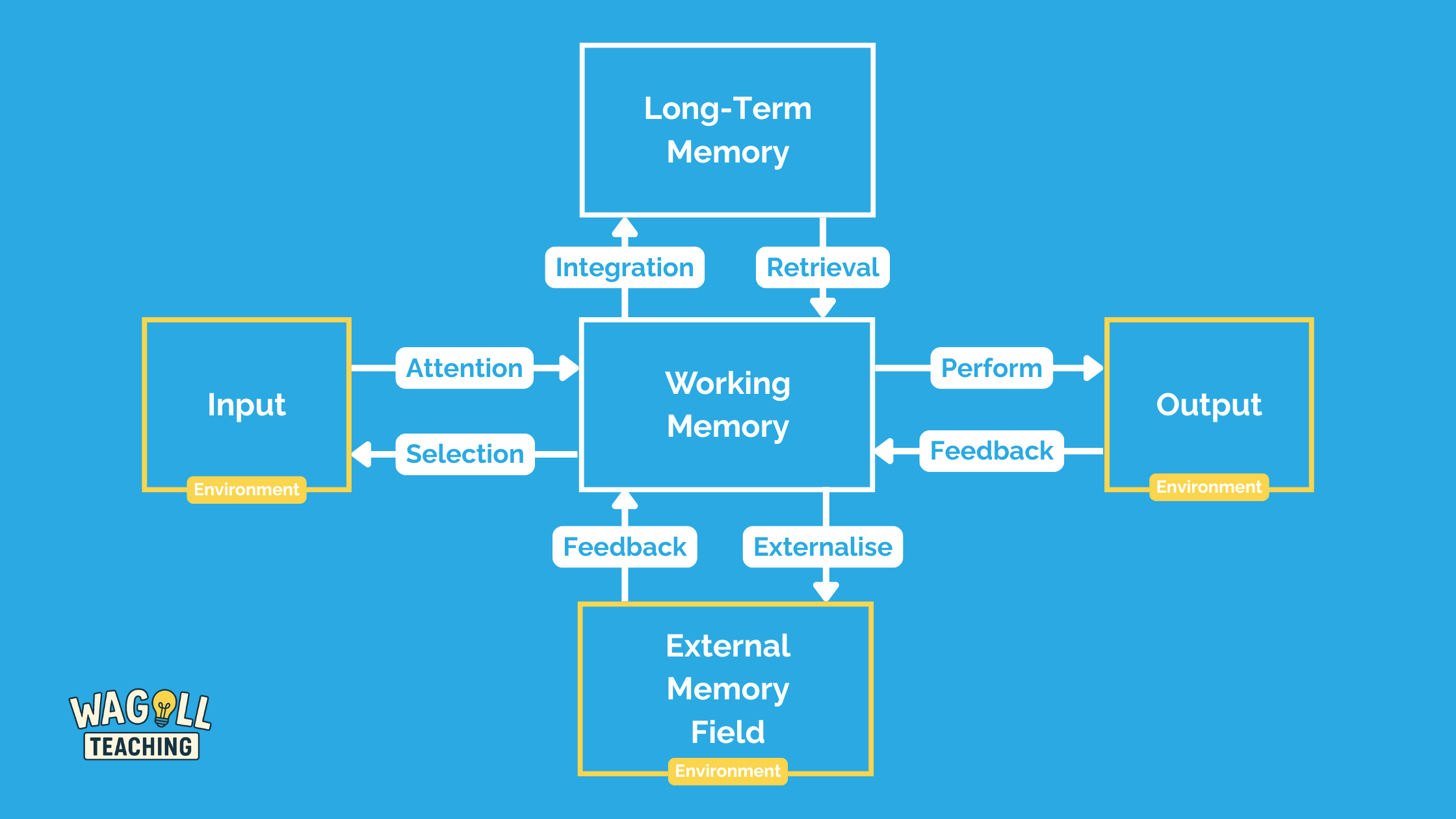
In a previous post on the Learning Within the Environment model, I wrote about the concept of the external memory field, a term originally used by evolutionary cognitive scientist Merlin Donald. Humans don’t do all their thinking internally. We constantly offload ideas into the world around us - onto paper, devices, gestures, notebooks, and shared visual spaces like display boards.
In the classroom, the whiteboard sits right at the centre of that external memory field. It allows children to take ideas that would otherwise sit inside working memory and place them into the environment where they can be manipulated, edited, refined and built upon.
👀 A Closer Look
🧩 Whiteboards as instructional feedback tools
In the Educakers post, they highlight several ways mini-whiteboards can appear across a lesson. Retrieval starters, sentence practice, idea collection and visual representation are just a few examples.
These examples illustrate just how versatile the tool really is. Whiteboards allow teachers to quickly see what pupils know, what they misunderstand and what needs revisiting. Instead of waiting until work is completed in books, teachers can respond in real time. Misconceptions become visible. Strong ideas can be shared. Instruction can be adapted immediately.
Seen this way, whiteboards act as powerful instructional feedback tools. They allow teachers to make rapid decisions about whether to adapt, reteach or extend learning within the moment. In the learning model below, this sits within the feedback loop between the external environment and working memory.
But there is another dynamic at play too. When pupils place their ideas on a whiteboard, something else is happening cognitively.
They are externalising their thinking.
🧠 Whiteboards as part of the external memory field
Working memory is limited. Children can only hold a small number of ideas in mind at once. When a task becomes complex - writing a sentence, solving a multi-step calculation, constructing a complex diagram or planning an answer - that working memory can quickly become overloaded. Whiteboards offer a way to ease that pressure.

By writing something down temporarily, pupils move ideas out of working memory and into the environment in front of them. Once those ideas are externalised, they stay in view but free up mental space for other thinking to take place. That thought, now sitting on the whiteboard, also becomes easier to manipulate. A word can be changed. A number can be adjusted or added to. A sentence can be extended. A diagram can be tweaked.
Thinking becomes visible, but also far more editable, malleable, and easier to build on because pupils no longer have to hold the original idea entirely in mind while trying to improve it.
In this sense, the whiteboard becomes part of the external memory field described by Donald. Instead of trying to hold every idea internally, pupils can distribute their thinking across the environment around them. The whiteboard becomes a space where thinking exists outside the mind and, because it does, becomes much easier to work with.
✏️ Whiteboards as a thinking and drafting space
This is where the whiteboard becomes particularly powerful in primary classrooms.
Unlike an exercise book, the whiteboard carries no sense of permanence. Marks can be wiped away instantly, never to be seen again. Mistakes feel less costly. That simple difference creates space for experimentation, revision and refinement before anything is committed to paper.
In other words, the whiteboard becomes a drafting surface for thinking. In an I Do, We Do, You Do, the whiteboard provides a great space for the We Dos to take place.
Take writing as an example. A pupil might begin with a simple sentence:
The park is dirty.
Once that thought is externalised on the whiteboard, working memory is freed up to think about improvements. The child might add an adverbial phrase:
Sadly, the park is dirty.
Then a conjunction:
Sadly, the park is dirty because people leave litter everywhere.
Then perhaps vocabulary might be improved or additional detail added.
At each stage, the sentence evolves in front of them. Words are erased. New ones are added. The sentence improves gradually rather than being constructed entirely in the mind.
The same process occurs in mathematics. Multi-step problems can be broken down and represented piece by piece. Pupils can sketch diagrams, test calculations and adjust their approach without the pressure of committing every attempt to a page in their exercise book.
The whiteboard becomes a workspace for thinking, not just a place to record answers. And when pupils finally transfer their learning into their books, much of the thinking has already taken shape. They are fully ready for the ‘You Do’.
⭐ WAGOLL+: The Primary Playbook
If you like this post, you’ll love the Primary Playbook for WAGOLL+ members – an ever-growing, primary-specific bank of one-page routines (Do Now, Learning Outcomes, To Knows, I Do–We Do–You Do, Hinge Questions, Show Me, Live Marking, Exit Tickets and more), each with a clear Why, What, and How to do it tomorrow plus KS1/KS2 tweaks.
All yours for just £2.50 a month.
✨ And so…
As the Educakers post captures so well, mini-whiteboards remain one of the most underrated and essential tools in the classroom because they make pupils’ thinking visible and allow teachers to adapt in the moment.
What I wanted to add through this post is this:
The humble whiteboard might be one of the simplest tools in the room, but when used deliberately, it becomes one of the most powerful ways for children to externalise thought, free up working memory, and refine ideas before they commit them more permanently to the page.
And when you see them that way, not just as “show me” boards, but as thinking boards, feedback enablers, drafting boards, and cognitive support tools, it becomes very hard to imagine teaching without them…
🧠 The Bits That Stick
✅ As Educakers highlight, mini-whiteboards are powerful instructional decision-making tools that allow teachers to adapt teaching in real time.
✅ Whiteboards also play a deeper cognitive role as part of the external memory field.
✅ By externalising ideas, pupils reduce working memory load and gain space to refine their thinking.
✅ Whiteboards are temporary, they encourage experimentation, editing and improvement before work is committed to exercise books.
In a bit,
Coops 😎
📚 References
Ball, R. (2024). The Scaffolding Effect: How to Help Students Learn. Woodbridge: John Catt Educational.
Clark, A., & Chalmers, D. (1998). “The extended mind.” Analysis, 58(1), 7–19.
Donald, M. (1991). Origins of the Modern Mind: Three Stages in the Evolution of Culture and Cognition. Cambridge, MA: Harvard University Press.
Educakers. (2025). Mini-Whiteboards Are Not Just for Hinge Questions. Substack. Available at: https://substack.com/@theeducakers/p-179163057
Jones, K. (2019). Retrieval Practice: Research & Resources for Every Classroom. Woodbridge: John Catt Educational.
Paivio, A. (1971). Imagery and Verbal Processes. New York: Holt, Rinehart & Winston.
Paivio, A. (1986). Mental Representations: A Dual Coding Approach. Oxford: Oxford University Press.
Sweller, J. (1988). “Cognitive load during problem solving: Effects on learning.” Cognitive Science, 12(2), 257–285.
Sweller, J., Ayres, P., & Kalyuga, S. (2011). Cognitive Load Theory. New York: Springer.
The idea of mini-whiteboards as part of the external memory field really resonates. In practice, you can see it immediately—students who might struggle to hold multiple steps in mind suddenly become more successful when they can “get it out” and work on it. It’s not just about checking answers; it’s about creating the conditions for thinking to happen.
What I particularly like here is the shift from “Show Me” to “Think Here.” That subtle change in purpose matters. If we only use whiteboards for quick responses, we risk underutilising them. But when they become a space for drafting, testing, refining—especially in that “We Do” phase—you start to see much richer thinking emerge.
In KS3, I’ve noticed this is just as powerful as in primary. Whether it’s planning a paragraph, mapping an idea, or breaking down a problem, the temporary nature lowers the stakes. Students are more willing to try, to change, to improve—because nothing feels final.
There’s also a strong link here to inclusion. For many learners, especially those who find writing or processing more demanding, whiteboards act as a bridge. They reduce cognitive load and increase participation at the same time.