



💡 The Big Idea
Great teaching is built on a deep understanding of how children learn and of the principles that guide expert instruction. When teachers base their practice on cognitive science and the best of what we know about classroom effectiveness, learning becomes more coherent, powerful, and memorable.
This post introduces a model of learning and eight core teaching principles designed to align classroom practice with how memory works. These ideas draw upon foundational research from cognitive psychology, assessment theory, and knowledge organisation.
👀 A Closer Look
🧠 The Learning Process
Learning is not just about exposure to new content — it’s about what the brain does with that content. Based on 1Willingham’s memory model and other leading research, this simplified process captures what needs to happen for long-term learning:
1️⃣ Filter – Directing attention to key information so it can enter working memory
2️⃣ Encode – Processing and organising that information to strengthen understanding
3️⃣ Consolidate – Strengthening schema and mental models in long-term memory
4️⃣ Retrieve – Accessing stored knowledge with increasing fluency and confidence
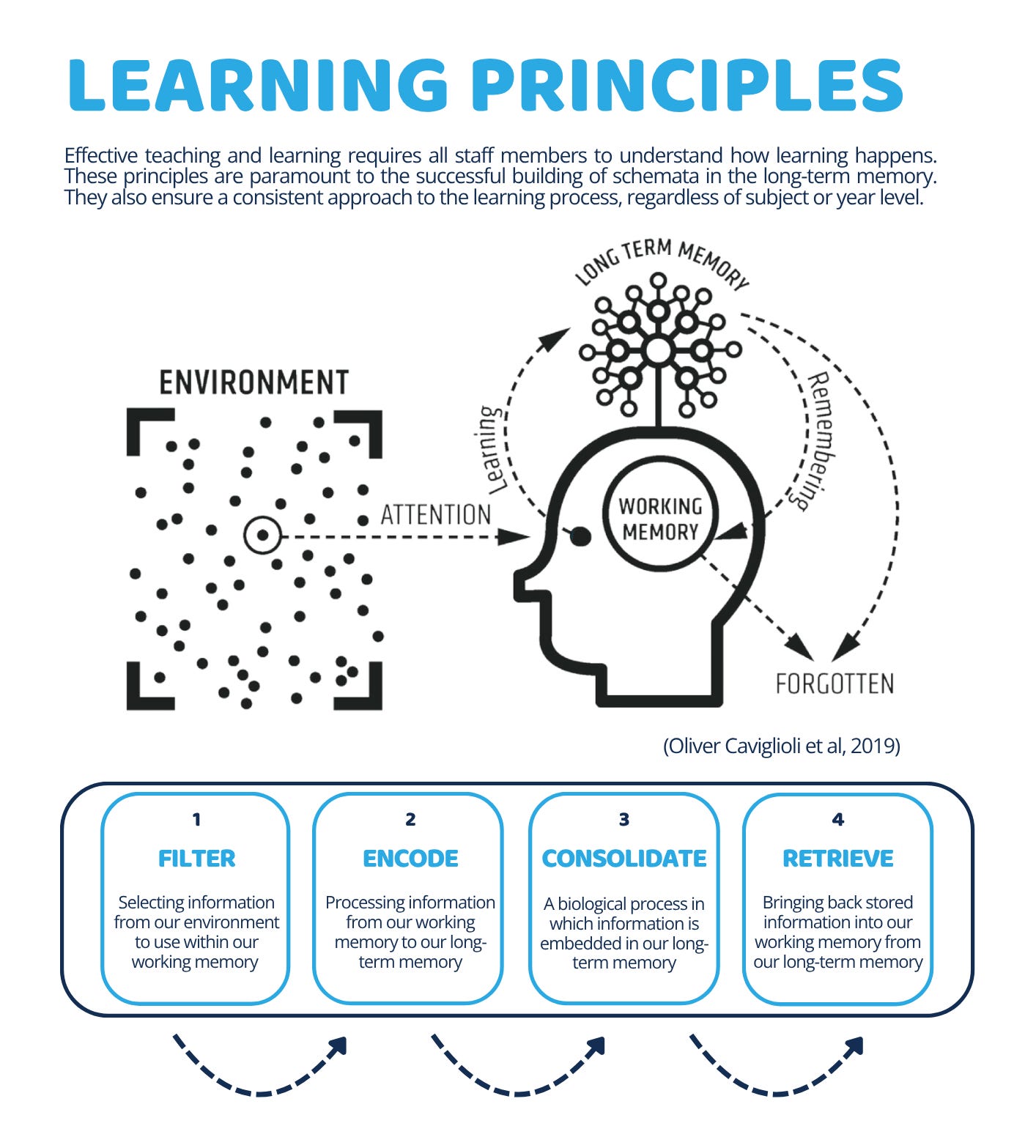
Visual model adapted from Organise Ideas by Oliver Caviglioli & David Goodwin (2020).2
🧑🏫 Our Teaching Principles
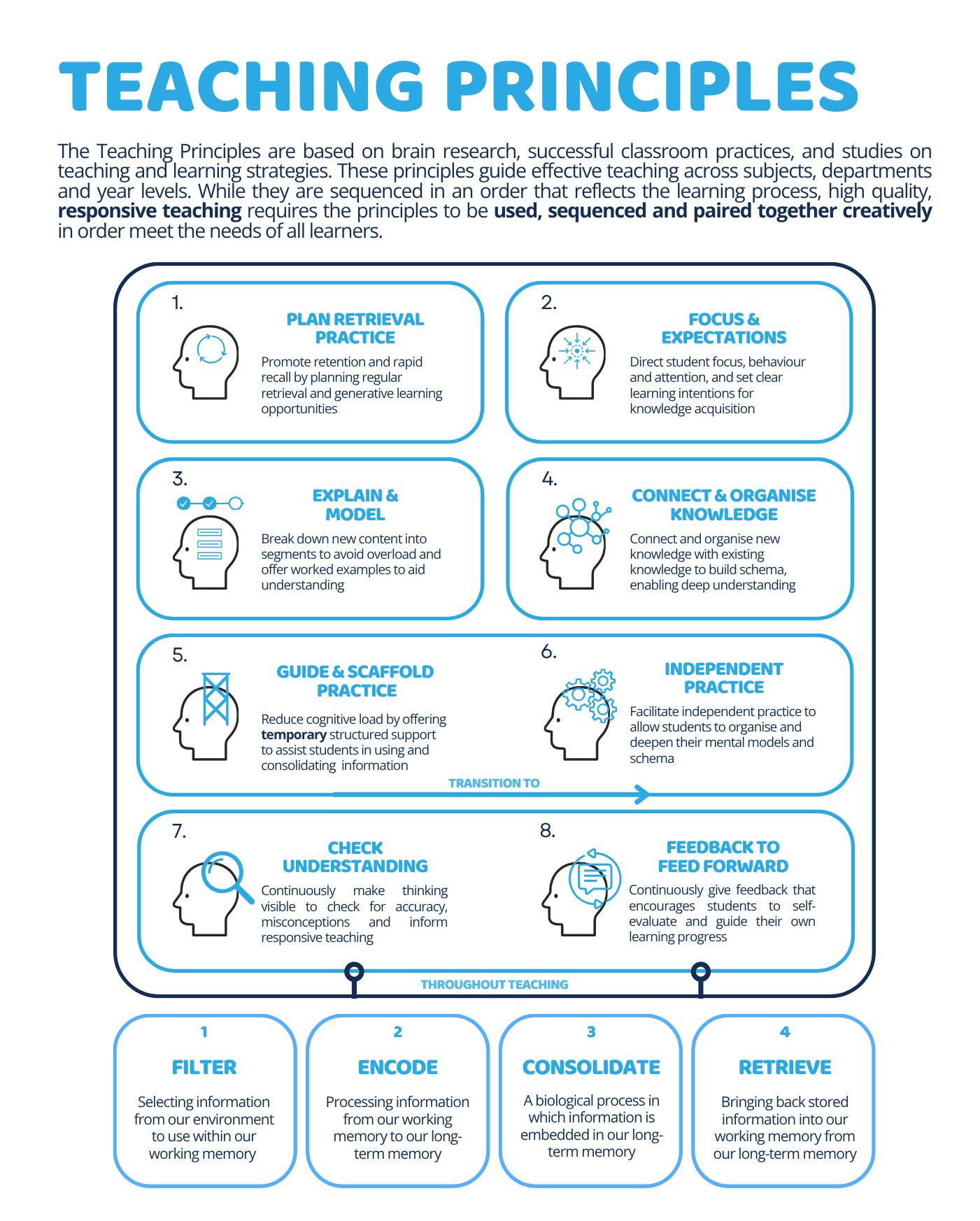
To support this learning process, we structure teaching around eight principles that ensure practice is high-impact, well-sequenced, and evidence-informed. The principles are a combination of Rosenshine, Wiliam and Cavliglioli. 3
🔹 1. Plan Retrieval Practice
Embed opportunities for retrieval and generative learning to strengthen memory and build fluency. Spaced and varied recall activities help pupils make knowledge more accessible and flexible.
🔹 2. Focus & Expectations
Set crystal-clear learning intentions and guide pupils attention to the most important information. Cue their working memory to what matters most.
🔹 3. Explain & Model
Avoid overload by breaking down new content. Use worked examples, clear explanations, and teacher thinking-aloud to make the invisible visible.
🔹 4. Connect & Organise Knowledge
Help pupils connect new learning to prior knowledge and organise it into schemas. This is where as strategies like chunking, comparing, sequencing, and cause-and-effect come into play.
🔹 5. Guide & Scaffold Practice
Support learners through structured practice. Gradually remove scaffolds as understanding grows, reducing cognitive load and fostering independence.
🔹 6. Independent Practice
Provide time for pupils to apply and use knowledge with minimal support. This solidifies understanding and encourages generative learning.
🔹 7. Check Understanding
Use questioning and observation to continuously gauge how well pupils are grasping content. Make it responsive, not reactive.
🔹 8. Feedback to Feed Forward
Use feedback to guide next steps. Feedback should move learning forward — whether through live interactions or targeted guidance — and help pupils take ownership of improvement. 4
❓ What About Questioning?
Questioning isn’t a standalone technique — it’s embedded across all teaching principles. A well-structured question can:
✅ Trigger retrieval
✅ Direct attention
✅ Check for misconceptions
✅ Support feedback and reflection
Instead of overcomplicating questioning, we treat it as a flexible, powerful tool that can support any phase of the teaching and learning, from activating prior knowledge to shaping next steps.
🧭 Wrapping It Up
Understanding the learning process helps us align teaching with how memory, attention, and understanding develop over time.
Grounding lessons in clear, evidence-informed teaching principles ensures that instruction is effective, purposeful, and high-impact.
Using a shared language and unified approach builds consistency across classrooms, supporting both teacher clarity and pupil success.
📝 More from WAGOLL Teaching
https://www.wagollteaching.com/blog/the-ultimate-feedback-toolkit#/ - Your guide to effective feedback that will also save you time!
5 Triggers to Boost Classroom Engagement: Harnessing Dopamine and Cortisol for Learning ➡️ Understanding how dopamine and cortisol influence classroom engagement
Retrieval Practice: 7 Activities That Work in Primary ➡️ A handy list of retrieval activities for Primary children
In a bit,
Coops 😎
📚 References
Willingham, D. T. (2009). Why Don’t Students Like School? Jossey-Bass.
Caviglioli, O., & Goodwin, D. (2020). Organise Ideas: Thinking by Hand, Extending the Mind. John Catt Educational.
Rosenshine, B. (2012). Principles of Instruction: Research-Based Strategies That All Teachers Should Know. American Educator, 36(1), 12–19.
Wiliam, D. (2011). Embedded Formative Assessment. Solution Tree Press.
Love how this bridges research and classroom practice.
Do you find certain principles (like scaffolding or consolidation) tend to be underutilized or misunderstood in practice? Would be curious to hear how your team supports consistency across classrooms.